
Welfare questions · Annotated comparison
Four ways a study might measure welfare
Behavioral observation, physiological measurement, physical or health indicators, and preference or motivation testing each produce a distinct kind of record, and none of them hands you “welfare” directly.
 By Nora Vance, Contributing writer · 8 min read · Published · Updated
What are the four ways to measure animal welfare?
Behavioral observation, physiological measurement, physical or health indicators, and preference or motivation testing each produce a distinct kind of record, and none of them hands you “welfare” directly. These are four useful ways to group measurements for reading a paper, not a universal welfare taxonomy. Each needs interpretation in its species, setting and observation period.
Behavioral observation typically means scoring an animal against an ethogram, a defined list of behavior categories, and logging how often or how long each one occurs. The NC3Rs guidance on evaluating environmental enrichment says enrichment evaluation often records behavior changes and includes ethogram-based monitoring among its approaches.
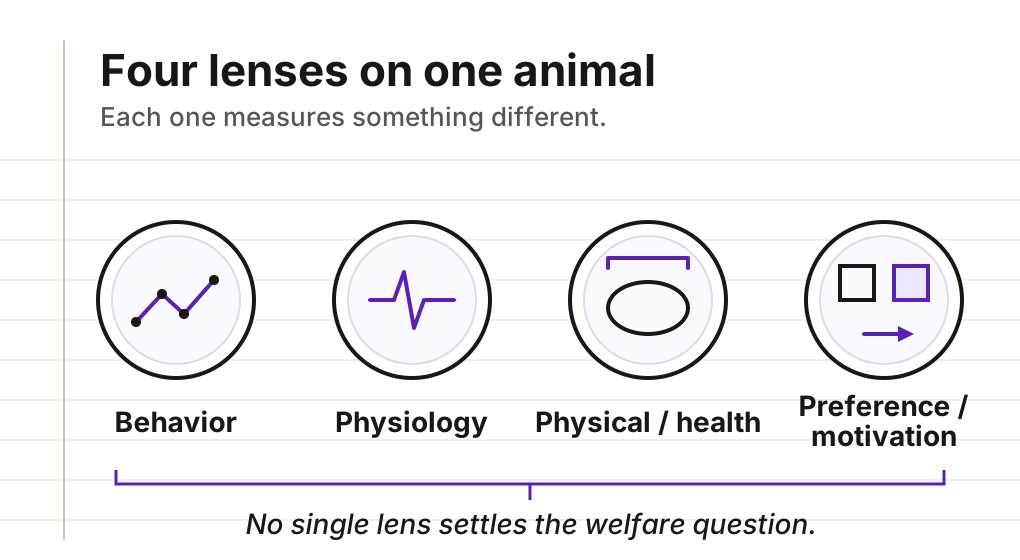
Physiological measurement records a bodily process, separate from an observed action. Cortisol levels in feces, used as a marker of stress, are one example the same NC3Rs enrichment guidance names directly. A hormone value reflects a physiological process over the period represented by the sample; it does not, by itself, tell you what the animal is experiencing.
Physical and health indicators sit closer to clinical inspection: body weight, coat condition, alopecia, wounds, posture. The NC3Rs welfare assessment guidance describes six broad categories that include appearance, body functions and behavior. Coat condition belongs under appearance; posture appears under behavior. Those source categories differ from the four measurement families used here.
Preference and motivation tests ask a different kind of question entirely: given a choice, or given a cost to pay, what does the animal select or work for? The enrichment evaluation guidance separates these into two distinct approaches, preference tests to see which of several enrichment items an animal chooses, and motivation tests to see how much effort an animal will expend to reach one.

These four families overlap in practice. A behavioral change (less social contact) can be recorded during a health inspection, a physiological reading can accompany a handling session, and a single welfare scheme routinely draws on more than one family at once.
The macaque-specific welfare assessment resource frames this directly: a comprehensive scheme draws together behavioral, physiological and clinical observations. Comparing measures collected at the same time can give a fuller assessment than relying on one indicator.
| Family | What is actually recorded | Example context |
|---|---|---|
| Behavioral | Frequency/duration of defined behaviors (ethogram) | Home pen observation, handling episodes |
| Physiological | Hormone or biomarker levels (e.g., fecal cortisol) | Sampling tied to a specific timepoint |
| Physical/health | Body weight, body condition score, alopecia score | Health inspection |
| Preference/motivation | Choice made, or effort expended, for an item | Structured choice or operant test |
How do you interpret a welfare measure?
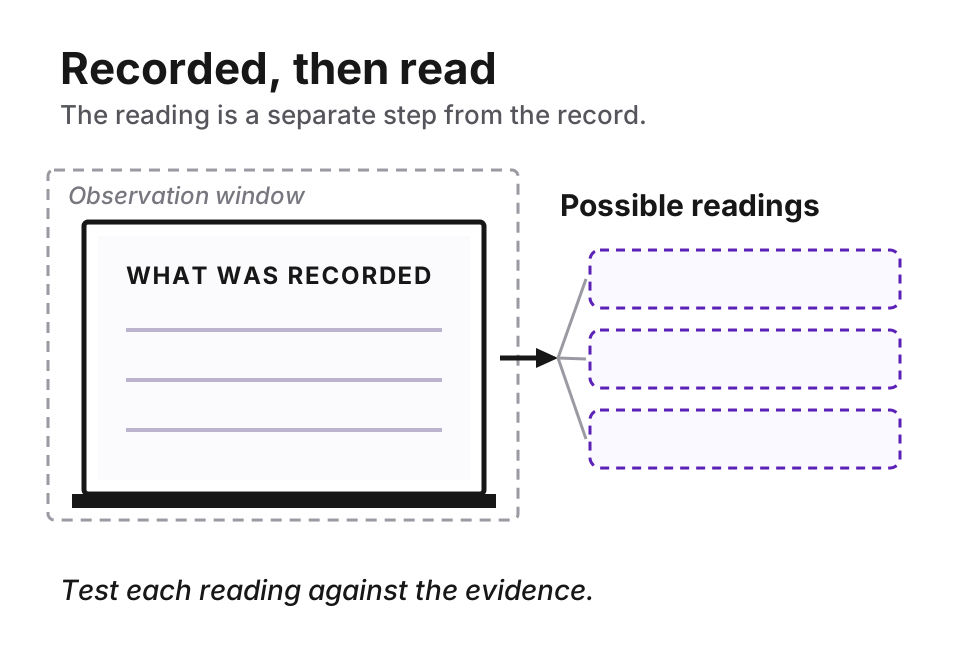
To interpret a number or observation, identify exactly what was measured and how the source relates it to welfare in that setting. The macaque welfare assessment resource makes this explicit by listing measures alongside their assessment location and their interpretation as positive or negative, because a raw value needs that context to mean anything.
Take heart rate. During conscious, restrained handling of laboratory macaques, a heart rate lower than normal is logged as a positive welfare interpretation, while a heart rate higher than normal is logged as negative, according to the same table in the macaque welfare assessment guidance. The reading itself is just a number from a monitor.

The positive or negative label attached to it is an interpretive step, tied to that specific context of conscious restraint.
Behavior works the same way, and the direction of “good” is not fixed. A broader behavioral repertoire in the home pen is listed as positive; a narrower one is negative. But more time spent in conspecific contact is listed as negative in that table, which runs against an intuitive assumption that more social contact is automatically good. Context, and the specific study population, set the interpretation.
Body condition scoring illustrates the same gap between record and reading. An improving body condition score above 2 is positive; a score decreasing below 2 is negative, per the same resource. Those thresholds belong to the scoring framework described for laboratory macaques, a specific research context. A pet at home would need a different framework entirely.
Whether that number reflects improving or worsening welfare depends on the direction of change and the scoring system in use, not the digit alone.
The NC3Rs welfare assessment guidance reinforces this by recommending an “ideal list of indicators” that combines objective criteria such as body weight with subjective indicators such as coat condition, posture, or social behavior. The welfare assessment guidance notes that severity classification is based on a review of accumulated day-to-day records, not a single reading or the type of procedure planned in advance.
Reading a welfare table means checking three things every time: what exactly was recorded, in what context it was recorded, and what direction the source assigns to that value for that species. Skipping any one of those steps turns a specific measurement into a guess.
When should welfare observations happen?
When an observation happens can change what it shows, sometimes as much as what is being measured. The NC3Rs welfare assessment guidance is direct about this: timing and frequency of observations should account for the animals’ normal activity patterns, the timing of procedures, and when suffering is more likely to occur.
Its example is species-specific and worth keeping that way. Rats and mice are nocturnal, so restricting observations to the light phase, the human working day, can mean missing important behavioral indicators during their normal active period. That is a stated limitation of daytime-only monitoring for those species, not a general rule for all animals.

The same guidance calls for increased assessment frequency around periods when adverse events are more likely, citing the post-surgical period and critical stages of disease studies as examples. A single assessment at a fixed daily time can miss a welfare decline that develops and resolves between checks.
The macaque-specific resource shows how observation location changes what gets recorded. Its comparison table separates measures taken in the home pen from measures taken during handling: a relaxed face and absence of vocalization during conscious, restrained handling are logged as positive, while loud, harsh vocalizations in that same handling context are negative.
A behavior only tracked in the home pen would miss the handling-specific signal entirely, and a behavior only assessed during handling misses whatever is happening in the pen. The macaque welfare assessment resource also references a validated framework for juvenile cynomolgus macaques in toxicology studies, where fluctuations in body weight and changes in activity budget were useful specifically during the pre-study acclimatisation period, one defined window within the study timeline.
Enrichment evaluation carries its own timing dimension. The NC3Rs enrichment evaluation guidance frames ethogram-based monitoring as comparing behavior in the presence and absence of an enrichment item, which means the observation window has to cover both conditions to produce a comparison at all. A single snapshot with the enrichment present tells you what the animal did with it there. Establishing a baseline calls for watching the same animal without the item too.
None of this suggests more monitoring is automatically better. It suggests matching the observation schedule to the species’ activity pattern and to the phase of the procedure or study, as the cited guidance sets out for the specific animals and contexts it addresses.
Keep disagreement in view
Different measurement families can point in different directions at the same moment, and the cited guidance treats that as something to manage on an ongoing basis, not something that resolves on its own. The macaque welfare assessment resource recommends triangulation, using a combination of measures collected at the same point in time, as a way to assess welfare using several measurements.
Disagreement is built into the framework’s own table. A macaque could show a relaxed face during handling (positive) while its body condition score is decreasing (negative), or stable body weight (positive) alongside a narrower behavioral repertoire in the home pen (negative).
The macaque welfare assessment guidance does not offer a formula for collapsing such combinations into one score; it presents multiple indicator types precisely so that no single measure carries the full interpretive weight.
The general NC3Rs welfare assessment guidance addresses this at a process level, not a statistical one. It recommends a “team” approach, incorporating researchers, veterinarians, animal technologists, and care staff, so that welfare assessment protocols are set up, reviewed, and revised with several kinds of expertise involved.
Periodic review of records is also recommended, to check that indicators are being applied consistently across observers and that suffering is being adequately recognized. These are organizational choices the guidance suggests for handling disagreement, separate from any empirical rule for which measure wins.
For UK animal research procedures, the guidance describes retrospective severity classification by a suitably qualified person using accumulated daily records. That is a separate reporting decision, distinct from deciding which of two conflicting welfare indicators is correct.
Free-text observation fields serve a related function. The welfare assessment guidance recommends a free-text box within a score sheet, so an observer can record an indicator of suffering missing from the predefined list.

That exists because predefined indicator sets can miss something, and unresolved or unexpected signals need somewhere to be logged even when they fall outside a set category.
Read the methods for how the researchers combined measurements and handled disagreement. The NC3Rs resources emphasize multiple indicators, trained observers and review of records. A paper that reduces those observations to one score still needs to explain the scoring rule and what that summary can miss.